Key Takeaways
- ✓Thailand's Y-series industry was projected to top 4.9 billion baht in 2025, growing ~17% a year, and the country now produces the majority of Asia's BL and GL drama.
- ✓The phenomenon is a deliberate soft-power play — backed by the government's THACCA push and trade agency — that channels global fandom into tourism, retail and brand spend.
- ✓Whether BL/GL is genuine queer representation or fan-service is a real, unresolved debate; for brands, the credible move is to invest in actual LGBTQ+ creators, not just the aesthetic.
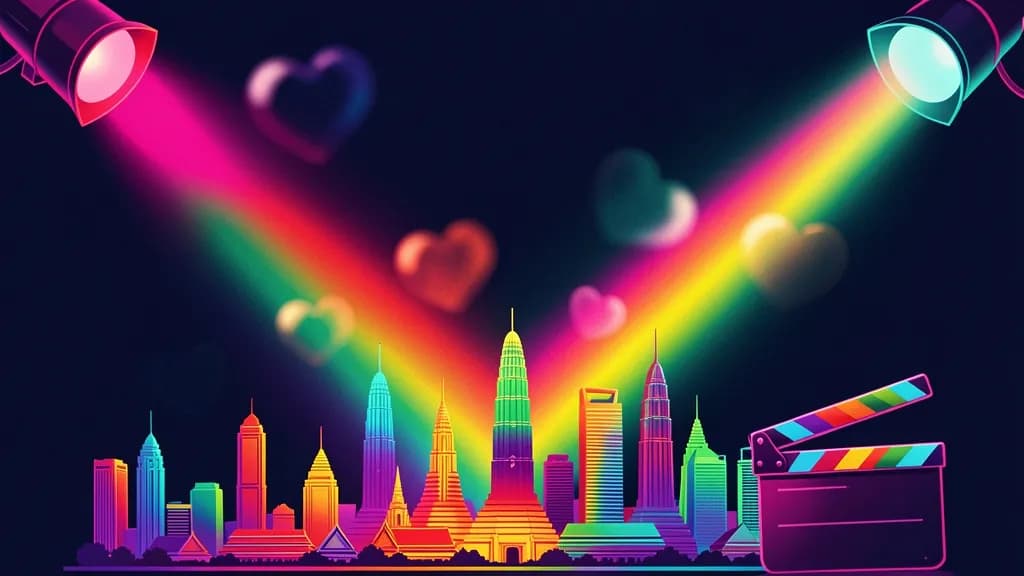
A decade ago, two boys almost-kissing on a Thai university campus was niche content — a low-budget genre with a cult following and little industry respect. Today it is one of Thailand's most valuable cultural exports, watched in São Paulo and Seoul, ticketed in Rome, and name-checked in cabinet-level soft-power strategy. Boys' Love (BL) and Girls' Love (GL) drama — known in Thai as ซีรีส์วาย and ซีรีส์ยูริ — have turned a country of 70 million into the world capital of queer-romance television.
For PrideShow, this matters beyond the screen. The same engine that exports a BL series exports a fandom, and that fandom spends — on travel, on merchandise, on the brands its idols endorse. It is the Pink Economy made visible. But the story has a sharp edge too: is BL/GL authentic LGBTQ+ representation, or is it queerness packaged for a largely straight audience? Both things can be true at once, and brands that want in need to understand the difference. Here is the industry, the money, and the debate — fairly told.
What BL and GL are — and why Thailand leads
BL (Boys' Love) and GL (Girls' Love) are romance genres centred on same-sex couples. The shorthand in Thailand is the 'Y' series — from the Japanese 'yaoi/yuri' lineage the form descends from — so the local industry, talent and studios are collectively called วงการวาย, and the production houses ค่ายวาย. The defining engine is the คู่จิ้น: a 'shipped pair' of lead actors whose on-screen chemistry is sustained off-screen through fan meetings, joint endorsements and social media, blurring the line between character and performer.
Several factors put Thailand ahead. It started early and built deep production know-how; it has a comparatively open social climate and a globally famous LGBTQ+ tourism brand; and — critically — Thai studios learned to monetise the fandom, not just the show. Where other markets treat BL as a side genre, Thailand built a vertically integrated machine around it: streaming, music, live events, and an idol pipeline. The audience, meanwhile, is overwhelmingly international and online, so a hit travels instantly.
~55% / ~60%
Thailand's share of Asia's BL / GL series production
2024 estimate — Thailand is the regional market leader for both genres.
The economics — market size, studios, exports
The numbers have moved from cult to corporate. Thailand's Y-series and gender-diversity content industry was projected to be worth more than 4.9 billion baht in 2025, growing at an average of roughly 17% a year. Its share of total Thai entertainment-media production value was expected to climb to about 3.9% in 2025, up from just 0.7% in 2019 — a more than five-fold jump in the genre's slice of the pie in six years.
At the top sits GMMTV, the dominant ค่ายวาย, which posted 2.463 billion baht in revenue and 126 million baht in net profit in 2024. But it is no longer a one-studio story — a competitive field of producers now publishes real, auditable results, a sign the genre has matured from passion projects into a sector with balance sheets.
| Studio | 2024 revenue (THB) | 2024 net profit (THB) |
|---|---|---|
| GMMTV | 2.463 billion | 126 million |
| CHANGE2561 | 442 million | 25 million |
| Domundi | 413 million | 29 million |
| Be On Cloud | 167 million | 15 million |
The on-screen revenue is only the first layer. Around it sits a fan economy of concerts, fan meetings and brand deals whose value spills into hotels, restaurants, airlines and small operators — part of why Thailand's broader entertainment-industry revenues were projected to exceed 700 billion baht in 2025. Fan meetings have themselves become a touring business: in 2025–2026, Thai BL and GL casts staged ticketed events across Asia, Europe and Latin America, with a run of shows scheduled in Rome alone.
From clip to plane ticket
International fans don't just stream — they search, translate, subtitle, buy tickets, support sponsor brands, and travel for fan events. That conversion from screen time to spending is the mechanism that turns BL/GL into Pink-Economy GDP.
Soft power and the Pink Economy
Thailand's government noticed. Since 2021, the Ministry of Foreign Affairs has actively promoted Thai BL dramas and idols abroad as instruments of soft power, and the genre now sits inside the national creative-economy agenda — channelled through bodies such as THACCA (the Thailand Creative Content Agency) and the Creative Economy Agency. The trade-promotion arm has approved Y-series projects for the 2026 fiscal year aimed at overseas markets including Brazil, Mexico, Spain, the United Kingdom and Australia — with the explicit instruction that fan meetings should bundle performance with culture, food, music and tourism.
The reference model is South Korea. K-drama and K-pop showed that cultural exports can drive tourism, language interest and national brand value for years. Thai officials and agencies increasingly view Y-series the same way: a content export that pulls a much larger economic tail behind it. For the Pink Economy specifically, BL/GL does something K-content largely did not — it makes queer narratives the headline product, putting LGBTQ+ romance at the centre of the country's outward cultural image rather than the margins.
“Many agencies now treat Y-series the way Korea once treated K-drama: a cultural export capable of generating real economic returns far beyond the screen.”
Is BL/GL real queer representation? The debate, fairly
This is where honesty matters. BL and GL are commercially huge, but their relationship to lived LGBTQ+ experience is genuinely contested — and PrideShow's view is that you can celebrate the industry and take the critique seriously at the same time.
The case for representation is real. Unlike classic 'queerbaiting' — defined by scholars as hinting at queerness while never actually delivering it — Thai Y-series openly depict same-sex couples, with explicit romance, kisses and love scenes. The genre has put queer relationships on mainstream screens across a region where that visibility is far from guaranteed, and many fans describe BL as a first, formative encounter with queer stories. Some academics argue the form opens space for genuine queer readings rather than foreclosing them.
The criticisms are also real, and they cluster around three points. First, the audience: Thai BL's core viewership is largely heterosexual women (สาววาย, the dedicated fan community) across Thailand, East Asia, Southeast Asia and Latin America — which raises the question of whether the genre is made for queer people or about them for someone else. Second, the คู่จิ้น machine: shipping real actors and selling their off-screen 'chemistry' can shade into queerness-as-product, and accusations of queerbaiting often surface when a beloved BL actor is revealed to be straight. Third, authenticity: some LGBTQ+ viewers say polished BL romances rarely reflect the harder textures of real queer life — discrimination, family, identity.
Even the actors have weighed in
The debate isn't only academic. A lead from the hit '2gether' publicly pushed back on fans collapsing the fictional pairing onto real life, invoking the language of exploitation himself — a reminder that the people inside the industry are wrestling with the same tension.
Recent scholarship reframes the whole argument: rather than a simple 'real or fake' verdict, researchers describe a 'queer fantasy economy' in which fan desire, commercial incentive and genuine visibility are tangled together and can't be cleanly separated. The useful conclusion for a brand or investor is not to pick a side but to act on the distinction: BL/GL is a powerful queer-coded cultural product, and it is not the same thing as platforming actual LGBTQ+ people. The most credible participants do both.
What it means for brands and the creator economy
If you are a brand, an investor or a platform, the takeaway is concrete. The BL/GL fandom is one of the most commercially active audiences on the planet — comparable to K-pop fandoms in how reliably it converts attention into spend — and it is disproportionately reachable through the creators it follows. Endorsements, fan meetings and integrated campaigns move product, and the audience is global, young and digitally native.
But association with queerness carries responsibility. The fastest way to lose this audience is to borrow the rainbow aesthetic for a campaign window while doing nothing for LGBTQ+ people the rest of the year — the marketing version of the queerbaiting critique above. The durable strategy is to back real creators and real inclusion: partner with verified LGBTQ+ talent, fund queer storytelling rather than just renting its imagery, and make commitments that outlast Pride month.
- Treat the fandom as a relationship, not a media buy — it rewards consistency and punishes opportunism.
- Vet who you platform: a credible BL/GL play centres actual LGBTQ+ creators and causes, not only the genre's surface.
- Measure the tail: a single endorsement can move fan-meeting attendance, tourism and retail — budget for the whole funnel, not just the post.
Find and verify LGBTQ+ creators and BL/GL talent to partner with — scored, not guessed.
Explore PrideShow's creator directoryFrequently asked questions
What does 'Y-series' mean, and how is it different from BL and GL?
'Y' is the Thai umbrella term (from the 'yaoi/yuri' lineage) for same-sex romance drama. BL (Boys' Love, ซีรีส์วาย) covers male couples; GL (Girls' Love, ซีรีส์ยูริ) covers female couples. 'Y-series' and วงการวาย refer to the whole industry, both genres included.
How big is Thailand's BL/GL industry?
Thailand's Y-series and gender-diversity content industry was projected to exceed 4.9 billion baht in 2025, growing about 17% a year. Thailand also produces an estimated ~55% of Asia's BL series and ~60% of its GL series, making it the regional leader.
Why is Thai BL called 'soft power'?
Because the Thai government actively exports it. Since 2021 the Ministry of Foreign Affairs has promoted BL dramas and idols abroad, and the genre sits inside the national creative-economy push (THACCA and related agencies), with 2026 trade projects targeting markets from Brazil to the UK — bundling fandom with tourism, food and culture.
Is BL/GL genuine queer representation or queerbaiting?
It's contested, and both critiques hold partial truth. Y-series openly depict same-sex couples (unlike classic queerbaiting), which is real visibility — but the core audience is largely heterosexual women and the 'shipped pair' model can commercialise queerness, drawing accusations of fan-service. The honest answer: it is a powerful queer-coded product that is not the same as platforming actual LGBTQ+ people.
How can a brand engage the BL/GL fandom responsibly?
Partner with verified LGBTQ+ creators, fund real queer storytelling rather than borrowing its imagery for one campaign, and make commitments that last beyond Pride month. The fandom is highly engaged and quick to call out opportunism, so consistency is the differentiator.
How Thailand's brands, studios and creators actually score on LGBTQ+ inclusion — measured, not marketed.
See the PrideShow Inclusion Index rankingSources
- The Nation Thailand — 'Thai BL and GL series move from niche content to billion-baht industry' (market value, ~17% growth, studio revenues, ~55%/~60% Asia share)
- Money & Banking Magazine — 'Thailand becomes the world's market leader for Y-series' (2025 projection, share of production value 0.7%→3.9%)
- Bangkok Post — 'How Thai Boys' Love series sparked a billion-baht fan economy and soft power revolution' / 'Exporting steamy soft power'
- Asia News Network / The Nation — 'Superfans turn T-pop into Thailand's next big export' (fandom economy, tourism spillover, DITP 2026 markets)
- Frontiers in Communication (2026) — 'Thai boys love series and idols: a new facet of soft power diplomacy in Thailand'
- Pang, K-W. & Li, E. C-Y. (2026), Media, Culture & Society — 'Queer fantasy economy: Rethinking queerbaiting through Thai Y-series drama and industry'
- Jirattikorn, A. (2025) — 'Chinese Fandom of Thai Boys' Love Dramas: Shipping the Queer Romance and Fan Service Practices'
- GMMTV — corporate overview (studio scale and output)