Key Takeaways
- ✓Where you buy decides who gets paid. The same rainbow T-shirt can fund a Thai queer designer's rent or a multinational's marketing budget that never reaches the community.
- ✓Rainbow-washing is real and checkable. Authentic Pride merch is made or owned by LGBTQ+ people, names where the money goes, and is backed by year-round inclusion, not a one-month logo swap.
- ✓Thailand's queer fashion scene is rich and findable: Chatuchak stalls, independent Bangkok labels, drag and ballroom designers, and a fast-growing gender-neutral movement.
- ✓Use a verified directory to find and vet LGBTQ+-owned brands, then support designers beyond June, when the discounts end but the rent does not.
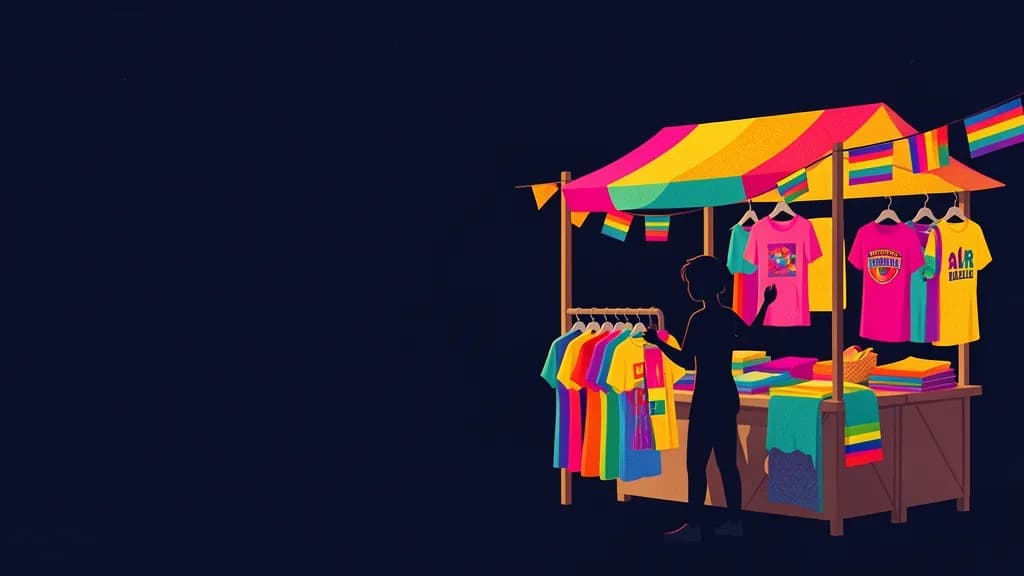
Every June, the rainbow shows up everywhere: on coffee cups, bank logos, shopfront windows, and a wall of identical Pride T-shirts at the mall. It feels like celebration, and some of it is. But behind two rainbow shirts that look almost the same can sit two completely different stories. One paid a Thai queer designer's studio rent and stitched a little money back into the community. The other funded a marketing campaign that vanishes on 1 July, while the brand's actual support for LGBTQ+ people stays at zero. This guide is about telling those two shirts apart, finding the real thing in Thailand, and making sure the baht you spend lands where you think it does.
This is not an anti-shopping article. Fashion is one of the most joyful, expressive ways people show who they are, and queer style has shaped global culture for decades. The point is simpler: when you choose where to buy, you are casting a small economic vote. In a country where the Pink Economy is now a multi-billion-dollar force, those votes add up. Spend them on the people who actually build the community, and you turn a Pride purchase into Pride support.
What we mean by "the Pink Economy"
The Pink Economy is the economic activity generated by LGBTQ+ consumers, businesses, and the organisations that serve them. In Thailand it spans tourism, finance, wellness, media, and a growing community of LGBTQ+-owned small businesses, including fashion labels and Pride-merch makers. When your money flows to those businesses instead of around them, the community keeps the value.
Why where you buy matters: the pink-baht case
Thailand's "pink baht" is no longer a niche idea. Industry estimates put the country's Pink Economy at roughly THB 10.3 billion in annual activity, with broader projections pointing toward THB 350 billion by 2030. Bangkok Pride 2025 alone was estimated to generate around THB 4.5 billion in economic impact and drew more than 300,000 marchers. LGBTQ+ travellers spend an estimated USD 1.5 billion a year in Thailand. Globally, the spending power of LGBTQ+ people is estimated at over USD 4.7 trillion. Those are big, attention-grabbing numbers, and that is exactly why every brand wants a slice of the rainbow.
THB 4.5B
Estimated economic impact of Bangkok Pride 2025
Up around THB 500 million on 2024, with 300,000+ marchers (Nation Thailand / Bangkok Pride organisers)
Here is the part that matters for your wallet. A number that large is only a community win if the money actually reaches the community. When a global brand sells a Pride collection, most of the margin flows back to shareholders and ad budgets. When a Thai LGBTQ+-owned label sells the same shirt, the money stays much closer to home: it pays a queer founder, hires queer staff, or funds a small donation to an LGBTQ+ group. Same purchase, very different destination. The pink baht only builds the Pink Economy when it circulates inside it.
The one-sentence test
Before you buy anything rainbow, ask: "If I spend THB 590 here, who actually gets paid, and does any of it reach LGBTQ+ people?" If you cannot answer, that is useful information by itself.
Authentic Pride merch vs rainbow-washing: how to tell
"Rainbow-washing" is when a company wraps itself in Pride colours to look supportive, without backing it up with real action, policy, or money for LGBTQ+ people. The rainbow becomes a sticker, not a stance. The reason this matters beyond aesthetics is money: a widely cited 2022 investigation by the newsletter Popular Information found that 25 corporations celebrating Pride had collectively donated more than USD 13.2 million to lawmakers who advanced anti-LGBTQ+ legislation. A rainbow logo on the storefront told customers one thing; the company's cheque book said another.
The good news is that authentic and performative merch leave different fingerprints, and you can learn to read them in about thirty seconds. Authentic Pride merchandise tends to be made or owned by LGBTQ+ people, says clearly where the money goes, and supports the community all year, not just for one rainbow-coloured month. Rainbow-washing tends to be vague, seasonal, and silent on the one question that counts: where does the money actually go?
| Signal | Authentic Pride merch | Rainbow-washing |
|---|---|---|
| Who makes it | LGBTQ+-owned or queer-designed; the people are visible | Anonymous supply chain; no community connection |
| Where the money goes | Names a beneficiary or donates a clear % to an LGBTQ+ group | No mention; "awareness" with no figures |
| Timing | Available and supportive year-round | Appears 1 June, gone 1 July |
| Substance behind it | Inclusive hiring, benefits, real policies | A logo swap and a hashtag |
| Storytelling | Tells a real founder or community story | Generic "love is love" with no specifics |
| Transparency | Happy to answer "who benefits?" | Deflects or stays silent |
A quick note on nuance: a big brand running a genuine, well-structured Pride campaign with a real donation and real internal policies is not the enemy, and a small seller slapping a rainbow on a cheap shirt is not automatically virtuous. The test is never the size of the company. It is whether LGBTQ+ people are actually better off because you spent the money. Authenticity is a behaviour you can check, not a vibe you have to trust.
The Thai queer fashion scene
Thailand has one of Asia's most vibrant and least-credited fashion cultures, and queer creativity sits right at the centre of it. You do not have to look hard, you just have to know where the energy is. Bangkok in particular runs on independent labels, market stalls, and a performance scene that doubles as a design incubator.
Markets and independent labels
Chatuchak Weekend Market is the obvious starting point and a genuine one: it is among the largest weekend markets on earth, with roughly 15,000 stalls and 11,500 vendors across 26 sections, and its clothing and designer zones are full of small Thai labels, hand-printed tees, and one-off pieces. Beyond Chatuchak, Bangkok's creative districts host independent designers working in streetwear, upcycled fashion, and bold graphic prints, often selling through Instagram, pop-ups, and weekend markets rather than department stores. Many of these makers are LGBTQ+ themselves or design explicitly for a queer audience, which is exactly the kind of brand worth seeking out.
Drag and ballroom as a design engine
Thai drag has gone global. Drag Race Thailand turned local queens into international stars, and Bangkok's nightlife and ballroom scene, including events like the Bangkok Vogue Ball, is a runway in the most literal sense. Drag fashion is a craft economy of its own: costume designers, beaders, wig makers, tailors, and stylists who build looks that influence mainstream style. Buying from, commissioning, or tipping these artists is one of the most direct ways to put money into queer creative hands. If you love a look from a show, ask who made it; many performers will happily point you to the designer.
“Queer fashion in Thailand was never waiting for permission. From Chatuchak stalls to the ballroom floor, it has always made its own runway and written its own rules.”
Gender-neutral and expressive fashion
One of the biggest shifts in global fashion is the move away from rigid "men's" and "women's" sections toward clothing that simply fits the person wearing it. This is not a fad. The unisex clothing market was valued at around USD 11.45 billion in 2025 and is projected to roughly double by 2033, and surveys suggest about 70% of Gen Z consumers are interested in buying gender-fluid fashion. Resale platforms have reported a roughly 30% rise in "genderless" tags in two years. The demand is real, mainstream, and growing fast.
~70%
of Gen Z consumers interested in gender-fluid fashion
A structural shift, not a seasonal trend, driving a unisex market on track to roughly double by 2033
For shoppers in Thailand, this is great news, because gender-neutral design and queer-owned design overlap heavily. Many of the same independent Thai labels making expressive, non-binary-friendly clothing are LGBTQ+-owned, so choosing them lets you shop your style and support the community in a single decision. Look for boxy unisex cuts, adjustable fits, neutral and bold colourways, and brands that describe their pieces by vibe rather than by gender. Expressive fashion is its own kind of Pride: you do not need a rainbow on the label to make a statement that is unmistakably yours.
How to find and verify queer-made brands
The hardest part of supporting LGBTQ+-owned fashion is not willingness, it is discovery and trust. Anyone can print a rainbow; far fewer can prove the business behind it is genuinely community-rooted. Here is a practical, repeatable way to find the real thing and check it before you pay.
- Start with a verified directory. Rather than guessing from a logo, browse a curated list of LGBTQ+-owned and -friendly Thai businesses where the listings are checked, so the rainbow is backed by a real, verifiable profile.
- Look for ownership or certification signals. Phrases like "LGBTQ+-owned," a verification badge, or an LGBTBE-style certification mean someone has actually confirmed the business is community-rooted, not just rainbow-branded.
- Read the brand's own words. Authentic labels tell you who they are, who they make for, and what they stand for. Vague, generic copy that could belong to anyone is a quiet red flag.
- Find where the money goes. Genuine Pride sellers will say if a percentage goes to an LGBTQ+ group, or at minimum will tell you plainly that buying directly supports queer founders and staff.
- Check the calendar. A brand that only exists in June is selling a season. A brand that shows up all year is building a business, and a community.
One quick guardrail
A rainbow on the packaging is design, not proof. Before you treat a purchase as community support, confirm at least one real signal: verified ownership, a named beneficiary, or a transparent answer to "who benefits?" If none of those exist, you are buying a colour, not a cause.
Find LGBTQ+-owned and -friendly Thai brands, vetted so the rainbow is backed by a real profile.
Browse the verified directoryBeyond the purchase: supporting designers year-round
Pride season is a spotlight, but rent, fabric, and wages are a year-round reality. The most meaningful support for queer designers is the kind that does not switch off on 1 July. Tellingly, in 2025 and 2026 many large brands actually went quieter on Pride, wary of backlash, which makes consistent grassroots support from shoppers more important, not less. The community designers do not have a marketing department to fall back on; they have you.
- Buy in the other eleven months, not just June. Off-season sales are when small labels need cash flow most.
- Follow, share, and tag. Visibility is free and genuinely valuable for independent makers who live on word of mouth and the algorithm.
- Commission custom pieces and tip performers. Drag artists, tailors, and beaders are running real creative businesses; direct work and direct tips matter.
- Choose queer-owned for everyday basics, not only statement pieces. A plain unisex tee from an LGBTQ+ label still moves money the right way.
- Leave honest reviews and refer friends. A good review can do more for a small brand than a one-off discount ever will.
None of this requires spending more money. It requires spending the same money with intention. Redirect a fraction of what you already spend on clothes toward verified queer-owned brands, keep doing it past June, and you become part of the infrastructure that lets Thai LGBTQ+ creativity thrive, not just for a month, but for a movement.
Frequently asked questions
What is rainbow-washing, in one line?
Rainbow-washing is when a company uses Pride colours and slogans to look supportive without backing it up with real action, policy, or money for LGBTQ+ people. The rainbow becomes branding instead of a genuine stance.
How do I know if a Pride product actually supports the community?
Check three things: who makes or owns the brand (look for LGBTQ+ ownership or a verification badge), where the money goes (a named beneficiary or a clear statement that it supports queer founders), and whether the brand is present all year rather than only in June. If a seller cannot answer "who benefits?", treat that as a red flag.
Where can I buy LGBTQ+ fashion and Pride merch in Thailand?
Look to Bangkok's independent labels, Chatuchak Weekend Market's clothing and designer sections, drag and ballroom artists who sell or commission custom pieces, and online queer-owned shops. The most reliable starting point is a verified directory of LGBTQ+-owned and -friendly Thai businesses, where the listings have been checked.
Is buying a Pride flag from a big retailer bad?
Not automatically. It is just less impactful for the community than buying from a queer-owned maker. If you want the flag and the support, look for a seller that is LGBTQ+-owned or donates a clear percentage to an LGBTQ+ group. The Progress Pride flag, designed by Daniel Quasar in 2018, adds black, brown, and trans-flag colours to centre people of colour and transgender people, which is worth knowing before you choose one.
What does gender-neutral or unisex clothing actually mean?
It means clothing designed to fit and suit a person regardless of gender, rather than being split into rigid "men's" and "women's" lines. It is one of the fastest-growing areas in fashion, and many gender-neutral Thai labels are also LGBTQ+-owned, so it is an easy way to shop your style and support the community at once.
How can I support queer designers without spending more?
Spend the same budget with intention. Buy from queer-owned brands for everyday basics, shop in the off-season when small labels need cash flow, follow and tag makers to boost their visibility, tip performers and commission custom work, and leave honest reviews. Attention and consistency cost nothing and matter enormously to independent creators.
Meet the Thai makers, designers, and shops building the Pink Economy from the ground up.
Explore LGBTQ+-owned small businessesSources
- Nikkei Asia, "LGBTQ-friendly Thailand chases $4.7tn rainbow economy" (asia.nikkei.com)
- Nation Thailand, "Bangkok Pride Festival Fuels THB 4.5 Billion Economic Boom" (nationthailand.com)
- Bangkok Post, "Govt to chase pink baht after Pride nets B4.5bn" (bangkokpost.com)
- ThaiPR.NET, "Pride Show 2026: Asia's First LGBTIQ+ Business Expo and the 10.3-Billion-Baht Pink Economy" (thaipr.net)
- FairPlanet, "Genuine Pride or corporate rainbow washing?" (fairplanet.org)
- Signal AI, "Brands Go Quiet this Pride Month, Fearing Rainbow Washing" (signal-ai.com)
- Shopify Blog, profile of LGBTQ+-owned apparel brand Awarewolf (shopify.com)
- Verified Market Research and industry reports on the gender-neutral / unisex clothing market, 2025-2033 forecasts
- Women's College Hospital and HRC, guides to the Progress Pride flag and its colours (womenscollegehospital.ca, hrc.org)